
Federal Quarantine Authority Gone Awry
University of Pittsburgh Journal of Health Law & Policy
ISSN: 3143-3545 | Vol. 1 | DOI 10.5195/pjhlp.2026.2 | upitthealthlawjournal.pitt.edu
Federal Quarantine Authority Gone Awry
Professor James G. Hodge, Jr., J.D., LL.M.
Sandra Day O’Connor College of Law, Arizona State University
Ask yourself – are you willing to set aside over 10% of your life this year, specifically forty-two consecutive days, to be physically corralled and medically monitored daily in a federal facility in Nebraska on the grounds that your potential exposure to a sometimes lethal disease, which is not easily spread person-to-person, may lead to your infection and threaten others? Nearly twenty Americans faced this same question recently regarding their willingness to be quarantined for a disease they did not have at the time and, ultimately, never contracted.
To be sure, the public health authority to quarantine individuals in the United States is well-established and practiced annually, largely through state and local governments. Thousands of Americans with active tuberculosis, for example, regularly adhere to home-based or limited institutional quarantines for the health and safety of their communities.
Yet, what the U.S. Centers for Disease Control and Prevention (CDC) conducted beginning in May 2026, tied to the hantavirus – Andes strain (Andes virus) outbreak on a foreign cruise ship, arguably exceeded effective, ethical, and lawful quarantine powers.
As one of the disgruntled U.S. passengers from the ship, Angela Perryman, publicly argued, CDC stretched the boundaries of its quarantine authority in her case while similarly situated passengers were exempted from heavier-handed measures.
Within the realm of mandatory social distancing powers, CDC's discordant approach to instituting quarantines forewarns its handling of additional persons exposed to Ebola and other dangerous, infectious diseases at home and abroad.
I. Hantavirus Outbreak at Sea
Perryman's and other passengers' odyssey into the depths of federal quarantine powers began on the Dutch cruise ship MV Hondius, which they boarded on April 1, 2026, in Argentina. After a few days at sea and stops at various ports, an outbreak of hantavirus arose from a single case detected on April 6. Multiple strains of hantavirus are typically transmitted through vermin, but only the Andes strain is known to be communicable person-to-person. Cases of Andes virus are rare but potentially deadly (up to a 35% fatality rate) with no known antiviral treatments.
After the initial infected passenger died on board on April 11, he was not removed from the vessel until April 24 at a port in Saint Helena. At that time, the deceased's wife also deboarded the ship, complaining of a similar illness. Two days later, on April 26, she expired. By May 2, another passenger died on board the ship under similar circumstances. By May 4, nearly a month since the initial case was detected, Andes virus was confirmed as the source infection. The World Health Organization, CDC, and other entities were alarmed by the prospect of a limited outbreak.
On May 10, the ship came into port in Spain's Canary Islands. Over 120 passengers, including eighteen Americans, were evacuated from the vessel. Earlier during the cruise on April 24, over two dozen passengers deboarded at one port after initial signs of infection surfaced. This initial group included seven Americans who returned to their homes, where they largely monitored their own health statuses under minimal state or local health agency oversight.
However, sixteen other Americans, including Perryman, who were still on the boat on May 10, were voluntarily taken to CDC's National Quarantine Unit (NQU) for further observation. Based in Omaha, Nebraska, this state-of-the-art facility is designed to safely house up to twenty persons known to be exposed to, or infected with, select, highly contagious conditions. Two other passengers joined the unit later from Atlanta.
Ultimately, a total of thirteen proven or highly suspected cases of Andes virus arose from passenger exposures on the ship, and three persons, as noted, perished. None of the cases, however, included any Americans.
II. Advanced Social Distancing Efforts
After largely agreeing to medical reviews and monitoring via CDC in Omaha, the group of eighteen Americans soon learned that their continued presence at the facility was not as voluntary as they were first told. Ten of them were able to negotiate their release and return to their prospective homes by May 31 in multiple states, including California, Arizona, New York, and Oregon. Each of these states' public health agencies agreed to conduct regular monitoring of these persons for the remainder of the forty-two-day quarantine period (which tolled from their last known exposures on the vessel on May 10).
Of the eight Americans who remained at the NQU, seven agreed to remain on site, submit to twice-daily medical monitoring, and patiently await the end of the quarantine period on June 22. Jake Rosmarin, a travel blogger on the ship, departed the unit that day for a flight to Boston, paid for by CDC. Applauding CDC for its efforts amid the relatively comfortable, hotel-like confines of the facility, Rosmarin also thanked the Omaha community that provided meals and other benefits during the stay.
The plight of Angela Perryman, however, sharply contrasted with that of her fellow quarantined castaways. Perryman, forty-seven, a native of Honduras lawfully residing in Florida, expressed her desire to leave the NQU early into her stay. CDC refused her request. Consistent with regulatory procedures, a formal order of quarantine was executed by CDC interim director, Dr. Jay Bhattacharya, on May 18. His order was confirmed two days later, on May 20, by Department of Health and Human Services (HHS) Assistant Secretary of Health Admiral Brian Christine, MD, following his medical review of Perryman's case.
It was a rare move for CDC to order quarantine for any condition, much less Andes virus. Never before had CDC used such orders for prospective exposures to the strain. Doing so in Perryman's case led to an extraordinary series of controversial legal and medical maneuvers culminating in her forced stay at the NQU for the duration of the forty-two-day period.
II. CDC's Quarantine and Isolation Authorities
Lacking legal training or initial access to attorneys, Perryman expressed her consternation largely through private interactions with CDC officials, as well as publicized interviews with major media outlets, including National Public Radio, the New York Times, and the Today Show. Among various complaints, she argued she was being forcibly held hostage at CDC's quarantine “prison” without legal justification.
To the extent she was not initially allowed to depart the facility on her own volition, she may have been right. Under Congressional delegation via the Public Health Service Act and pursuant to CDC public health regulations, federal officials can issue initial orders to detain persons entering the country who are suspected of exposure to or infection with specific communicable conditions for a seventy-two-hour initial observation period.
After this initial three-day apprehension, confining persons against their will for quarantine (applying to persons suspected or known to be exposed to communicable conditions) or isolation (applying to persons suspected or known to be infected with such conditions) requires a formal federal order. Unless CDC obtained such an order requiring Perryman to remain at the NQU, she was free to leave anytime.
It was not until May 18 – eight days after her apprehension – that CDC issued its first order of quarantine against Perryman (and one additional individual). It relied on its inherent legal capacity to protect the public's health from potentially deadly diseases. Yet, Dr. Bhattacharya's order raised significant legal issues from the onset. Foremost among these were doubts about the explicit legal bases for quarantining persons exposed to Andes virus.
While CDC's social distancing powers extend nationally, they are considerably more limited than state-based public health powers. CDC cannot issue quarantine orders for persons exposed to just any communicable disease. Only specific infectious diseases appearing on a federal list of conditions directly authorized via Presidential Executive Orders (E.O.) may justify CDC quarantines. Diseases like cholera, yellow fever, plague, and smallpox are most definitely on the list. Andes virus, at first glance, is not.
The question of whether CDC could quarantine anyone for exposure to Andes virus at all arose. To meet this threshold, CDC observed how the Andes strain can lead, in rare cases, to hantavirus pulmonary syndrome (HPS), a potentially fatal condition that likely contributed to the fatality of three other passengers on the ship. HPS is also not explicitly among the listed communicable conditions subject to CDC quarantine authority. Yet, it is arguably classifiable as a “severe acute respiratory syndrome,” or SARS. In 2014, President Obama amended the quarantine list via Executive Order (E.O.) 13674 to include SARS, defined as:
… diseases [other than influenza] that are associated with fever and signs and symptoms of pneumonia or other respiratory illness, are capable of being transmitted from person to person, and that either are causing, or have the potential to cause, a pandemic, or, upon infection, are highly likely to cause mortality or serious morbidity if not properly controlled.
Though HPS and its root cause, Andes virus, were not likely in mind when President Obama clarified the scope of SARS illnesses, given the rarity of HPS outbreaks, they arguably fit under this definition.
IV. Haphazard Applications of Federal Quarantine Powers
CDC met initial requirements for imposing its quarantine order impacting Perryman, but legal and practical challenges remained. For starters, federal quarantine authority requires that the CDC Director have a “reasonable belief” that an individual was exposed to communicable conditions. Just because Perryman was on the ship does not immediately suggest that she, or others, were exposed to Andes virus. Epidemiologic evidence underscores this observation. Of the over 120 passengers and thirty crew who remained on the ship after the Andes virus outbreak was confirmed, only thirteen (8.6%) ever contracted the disease.
CDC's posted information about the unlikelihood of person-to-person spread of Andes virus is equally telling: “This spread is usually limited to people who have close contact with a sick person. This includes direct physical contact, prolonged time spent in close or enclosed spaces, and exposure to the sick person's body fluids.” Perryman argued she had no such sustained contact with any known infected persons on the ship (although she admitted to having brief discussions with one of the passengers who later expired) and thus should not be forcibly quarantined on mere suspicion.
However, CDC could not know who may have been sufficiently exposed to the virus when it instituted its order. The agency sought to avoid taking chances that could lead to the domestic spread of Andes virus. Even this observation is legally challengeable on two premier grounds. First, CDC allowed at least seven other Americans who departed the ship ahead of its port in Spain on May 10 to return to their homes and engage in limited quarantine measures. Perhaps these Americans' exposures to Andes virus were minimized by their early departure on April 24. This position would be reasonable, except that CDC itself suggested they pose similar “high risks” for potential infection as all of the others who remained on the craft.
Second, after its initial quarantine order against Perryman, CDC reconsidered the public health risks presented by most of the Americans at its NQU. One of CDC's medical officers determined in late May that the risks of infection no longer warranted full-scale quarantine. Rather, these persons could return to their homes subject to limited home quarantines overseen by state or local public health authorities. CDC's Interim Director, Dr. Bhattacharya, agreed, formally amending his quarantine order on May 31.
Shortly thereafter, ten Americans left the NQU to return to their home states, which helped with their minimal monitoring via home quarantine. Seven other Americans volunteered to stay at the NQU. Perryman desperately sought to return home to Florida like most of the others, but public health authorities there refused to adhere to CDC's demands, including that police officers be stationed 24/7 outside the residences of those returning from the NQU. Florida Surgeon General Dr. Joseph Lapado wrote to CDC, concluding it was unnecessary to implement such measures. Absent Florida's acquiescence in CDC's quarantine requisites, Perryman seemingly would have to remain at the NQU for the entire forty-two days.
V. Unprecedented Legal Machinations
At this juncture, Perryman's case further deteriorated into an abyss of federal bureaucracy. On May 31, CDC's director of the Division of Global Migration Health, Dr. David Fritter, concluded that Perryman must remain at the NQU. Dr. Fritter's assessment, coupled with Florida's continued refusal to implement CDC's at-home monitoring, was backed up by HHS Admiral Dr. Christine on June 3.
On June 4, Perryman sought input from two experienced doctors outside of CDC, Demetre Daskalakis and Jeremy Faust. They concluded that CDC lacked legal and public health justification for differentiating Perryman's quarantine status from others, essentially finding a lack of clear and convincing evidence to restrain her in violation of her civil liberties.
Then, following a formal hearing as part of another round of required internal medical reviews, CDC's internal medical reviewer, Dr. Michael Bell, concurred with Dr. Daskalakis and Dr. Faust on June 11. Dr. Bell concluded that Perryman's continued containment at the NQU was unwarranted in line with legal requirements for CDC to utilize less restrictive social distancing measures where possible. So long as Florida's Department of Health agreed to daily monitoring and other public health assistance, noted Dr. Bell, Perryman should be allowed to return home. The path finally seemed clear for her to depart the NQU just eleven days prior to the end of the mandatory quarantine period.
Incredulously, Florida public health authorities continued to object to CDC's limited terms of release that required state monitoring for less than a week. On June 15, HHS Secretary Robert F. Kennedy Jr. entered the fray in an unprecedented fashion. Bypassing Dr. Bell's recommendation as well as any subsequent action by Dr. Bhattacharya, Secretary Kennedy ordered Perryman to remain at CDC's NQU. Offering no new evidence or support for his decision, Secretary Kennedy's order negated any chance Perryman would be released ahead of schedule, absent judicial intervention, which never came.
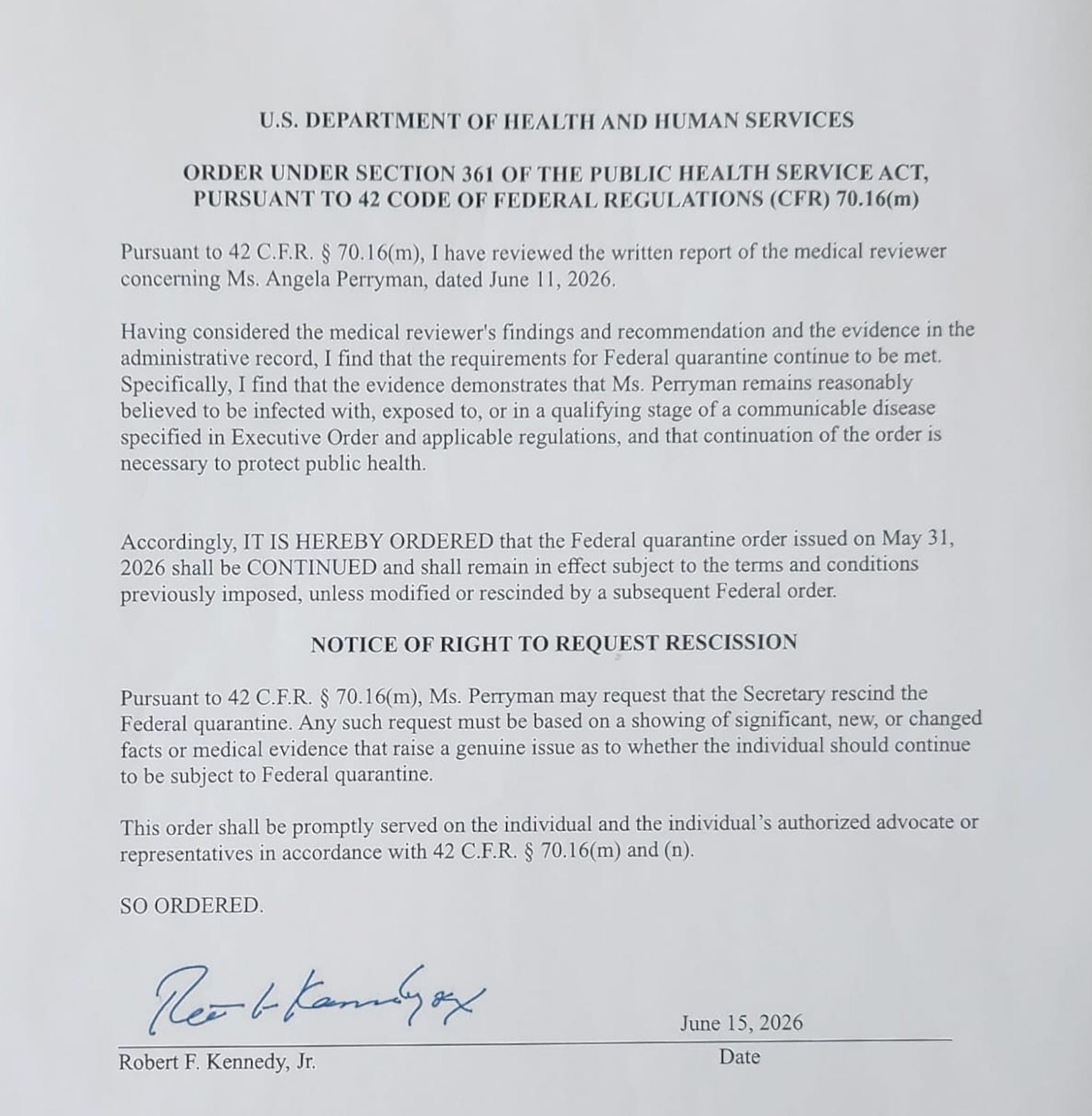
As Perryman opined prior to her release on June 22, “… there's clearly no longer any public health justification for [Secretary Kennedy's] actions and no protections against executive overreach for anyone. This is Secretary Kennedy asserting the right to detain any American, for any reason, for any period he sees fit, with no judicial oversight.” Perryman's lawyers have indicated she is considering litigation since being freed.
VI. Improving Federal Quarantine Implementation
Prevailing outcomes of CDC's approaches to social distancing, including dozens of Americans allegedly exposed to Andes virus, are noteworthy. Foremost, no American ever contracted the disease from this limited outbreak; not on the ship, not at CDC's facility, and not at home. It is a public health accomplishment given the morbidity and mortality surrounding Andes virus, with no known vaccines or cures, even if the virus is not that easily transmitted.
The morass underlying this achievement, however, relates to whether individual rights and liberties were trampled in the process. For the thirty or so Americans directly impacted by the outbreak while aboard the ship, CDC may rightfully claim its quarantine stances were successful. Despite some complaints about conditions at the NQU, issues of social isolation there or at home, and contrary views of state or local public health agencies on the need for strict social distancing, nearly everyone at risk of the Andes virus outbreak came away unscathed. Temporary losses of liberty were, for most, perhaps a worthy sacrifice.
These persons, however, are not the “poster cases” for what can go awry in the implementation of quarantine measures; Angela Perryman is. And what primarily went wrong in her case is CDC's purported characterization of her unique requests to be freed from its facility as a threat to the public's health, despite other, seemingly similarly situated Americans' ability to reside at home.
CDC's justifications for its approach in Perryman's case are unclear. CDC delineates that decisions as to the residency of persons potentially exposed to Andes virus include their access to health services, comorbidities, living environment itself, willingness to comply with public health directions, and ability to perform essential daily tasks.
Neither Dr. Bhattacharya nor Secretary Kennedy sufficiently communicated why Perryman's confinement contrasted with that of others. Instead, they repeatedly point to: (i) CDC's overall legal authority to quarantine, (ii) their attempts to follow regulatory processes, and (iii) the general need to protect the public's health. If Perryman presented some ostensible harms or risks that CDC determined from her proximity to known infections on the ship or because of her recalcitrant behaviors and demands while at the NQU, such observations are not publicly known.
What is known in the annals of public health law is that unwarranted infringements of civil liberties in the guise of protecting communal health are unlawful and unwise. They create lasting public memories of cases of alleged governmental overreach. Few will remember the over two dozen Americans who largely adhered to CDC quarantines on their own. They will recall the one American who was involuntarily confined for specious reasons. People influenced by such cases may actively seek to avoid future public health interventions despite their own or others' health risks.
CDC and other public health agencies might avoid generating controversies surrounding quarantine cases ahead of time without risking the community's health through the following:
- Be transparent on the bases for which social distancing measures are fully warranted.
- Utilize medical reviewers from outside CDC and HHS to validate the need for quarantine.
- Adherence to federal bureaucracy is not a substitute for effective due process. Depriving Americans of constitutional rights through bureaucratic processes is unlawful.
- Similarly situated persons exposed to communicable diseases deserve similar treatment. It is that simple – and it is constitutionally required under the Fourteenth Amendment's Equal Protection Clause.
- Apprehending persons suspected of disease exposures based on “reasonable beliefs” may survive scrutiny in real emergencies, but depriving liberties absent clear and convincing evidence of palpable threats to the public's health is untenable.
- Save stringent measures like federal quarantine orders for sensational health conditions (e.g., Ebola virus) that spread more easily among persons.
- Rely on the implementation of state quarantine powers instead of federal regulations under principles of cooperative federalism.
- Where cooperative federalism breaks down, work with affected individuals to find alternatives protective of individual liberties.
- Ground quarantine policies in epidemiological evidence. While Andes virus infections can arise up to forty-two days after initial exposure, CDC notes they are more likely to occur in the first eighteen days, suggesting home quarantine approaches thereafter may have been appropriate.
James G. Hodge, Jr., JD, LLM, is the Peter Kiewit Foundation Professor of Law and Director of the Center for Public Health Law and Policy at the Sandra Day O’Connor College of Law, Arizona State University, and author of Public Health Law in a Nutshell, 5th Ed. (West Academic 2024).
New articles in this journal are licensed under a Creative Commons Attribution 4.0 United States License.
This journal is published by Pitt Open Library Publishing.